


When you’re far from civilization, the right knife can mean the difference between thriving and surviving. Multi-purpose hunting knives are more than tools they’re essential for outdoor challenges.
From dressing game and preparing meals to building shelter and tackling survival tasks, a good knife is your most reliable companion, combining precision and durability for tough jobs.
Understanding Multi-Purpose Hunting Knives
A multi-purpose hunting knife earns its designation through careful engineering that balances multiple competing demands. Unlike specialized tools designed for single tasks, these knives must excel across various applications without compromising performance in any critical area.
The foundation of any multi-purpose knife lies in its blade geometry. The optimal design features a blade length between 4-6 inches, providing enough cutting surface for larger tasks while maintaining the maneuverability needed for precision work. The blade profile typically incorporates a slight curve or drop point, allowing for both slicing motions and controlled piercing.
Steel quality determines longevity and performance consistency. High-carbon stainless steels like 440C or VG-10 offer excellent corrosion resistance while maintaining edge retention. Carbon steel options like 1084 or 5160 provide superior sharpness and easier field sharpening, though they require more maintenance in humid conditions.
Handle construction significantly impacts functionality. Ergonomic designs with textured grips ensure secure handling in wet conditions, while full-tang construction provides the strength needed for heavy-duty applications. Materials like G10, Micarta, or quality polymers offer durability without excessive weight.
The balance between durability, sharpness, and versatility requires compromise and prioritization. Thicker blade stock increases strength for batoning and prying but reduces slicing efficiency. Harder steel holds edges longer but becomes more difficult to sharpen in the field. Understanding these trade-offs helps you select a knife aligned with your primary activities.
Survival Knives vs. Camping Knives: What’s the Difference?
The distinction between survival and camping knives reflects different priorities and usage scenarios, though quality examples of each category can serve multiple roles effectively.
Design Philosophy and Construction
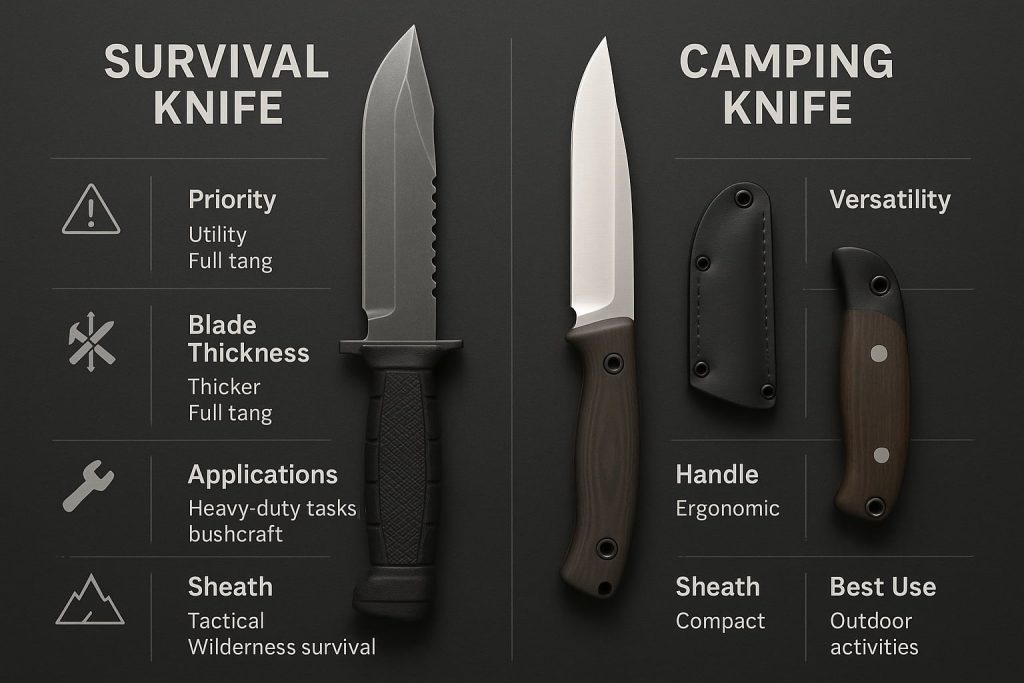
Survival knives prioritize robustness and reliability above all other considerations. These tools feature thick blade stock, typically 3/16 inch or more, designed to withstand batoning, prying, and other high-stress applications. The blade profile usually incorporates a straight or slightly curved cutting edge with a reinforced tip capable of piercing and drilling.
Full-tang construction is standard in survival knives, extending the blade metal through the entire handle length. This design distributes stress across the entire tool, preventing handle separation during demanding tasks. The spine often includes jimping or a sharp 90-degree angle for striking ferro rods and scraping tasks.
Camping knives emphasize cutting performance and user comfort for typical camp tasks. These designs feature thinner blade stock, usually around 1/8 inch, optimizing slicing efficiency for food preparation, rope cutting, and general utility work. The reduced thickness improves cutting geometry while maintaining adequate strength for normal camping applications.
Intended Applications
Survival knife applications include emergency shelter construction, fire preparation through batoning, emergency signaling, basic tool making, and self-defense scenarios. These knives must function when other tools fail, often serving as the primary implement for creating additional tools and solving unexpected problems.
The survival mindset assumes worst-case scenarios where the knife might be your only tool. Features like hollow handles for storage, saw teeth on the spine, or integrated fire starters reflect this comprehensive approach to emergency preparedness.
Camping knife applications focus on established campsite activities: food preparation, rope and cordage cutting, basic maintenance tasks, and light wood processing. These environments typically include other tools, allowing the knife to specialize in cutting tasks rather than serving as a universal problem-solver.
Feature Comparison
Survival knives commonly include aggressive blade coatings for corrosion resistance, oversized guards for hand protection during forceful use, and comprehensive sheath systems with additional tools or fire-starting materials. Weight becomes secondary to capability and redundancy.
Camping knives emphasize refined cutting geometry, comfortable extended-use handles, and optimized weight-to-performance ratios. Blade coatings focus on food-safe options, while sheaths prioritize convenient carry and quick access rather than comprehensive tool storage.
Situational Preferences
Extended wilderness expeditions favor survival knife characteristics, particularly when traveling light or in challenging environments. The additional weight and bulk justify themselves through increased capability and reliability margins.
Established camping scenarios, car camping, or day hiking often benefit from camping knife advantages. The improved cutting performance and reduced weight enhance the outdoor experience without sacrificing necessary functionality.
The Most Versatile Knife for Survival
Identifying the most versatile survival knife requires evaluating specific characteristics that contribute to multi-role effectiveness across diverse scenarios and conditions.
Critical Blade Characteristics
Blade length significantly impacts versatility, with 5-6 inches providing the optimal balance for most users. This length offers sufficient cutting surface for processing tasks while maintaining the control needed for detailed work. Shorter blades limit processing capability, while longer options become unwieldy for precision tasks.
Blade thickness around 3/16 inch provides the strength needed for batoning and prying without excessively compromising cutting geometry. Thicker options increase durability but reduce slicing efficiency, while thinner designs improve cutting but limit heavy-duty applications.
Drop point or clip point profiles offer superior versatility compared to tanto or other specialized shapes. The curved belly excels at skinning and slicing tasks, while the controlled point allows precise piercing and detailed work. Straight-backed designs provide consistent spine geometry for ferro rod striking.
Steel Selection for Versatility
Carbon steels like 1084, 5160, or O1 provide exceptional sharpness and field sharpenability, crucial factors for extended wilderness use. These steels achieve razor-sharp edges and respond well to simple sharpening methods, though they require diligent maintenance to prevent corrosion.
Stainless options like 154CM, S30V, or VG-10 offer reduced maintenance requirements and consistent performance in humid conditions. Modern powder metallurgy stainless steels rival carbon steel performance while providing superior corrosion resistance, though they typically require more sophisticated sharpening tools.
The choice between carbon and stainless steel often depends on expected conditions and maintenance preferences. Humid coastal environments favor stainless construction, while dry climates allow carbon steel advantages to shine.
Handle Design and Ergonomics
Full-tang construction with properly scaled handles provides optimal strength and control for versatile applications. The continuous steel structure eliminates weak points while allowing customization of handle materials for specific preferences and conditions.
Handle materials like Micarta, G10, or quality hardwoods offer excellent grip characteristics across various conditions. Textured surfaces provide secure hold when wet, while contoured shapes reduce hand fatigue during extended use.
Length and circumference must accommodate various grip positions for different tasks. A handle length of 4.5-5 inches allows full-hand grips for power tasks while providing adequate control for detail work. Slightly oval cross-sections prevent rolling while maintaining comfort.
Examples of Versatile Designs
The Benchmade Bushcrafter exemplifies modern versatile design with S30V steel, comfortable handle ergonomics, and excellent heat treatment. The 4.43-inch blade provides capable performance across multiple roles while maintaining reasonable weight and size.
Traditional options like the Ka-Bar USMC Fighting Knife demonstrate time-tested versatility through decades of military and civilian use. The simple design, proven materials, and robust construction create a reliable tool for demanding applications.
Custom makers like Tom Brown Tracker knives incorporate unique design elements aimed at maximizing versatility, though complex geometries can compromise performance in some applications while improving others.
Choosing Your Multi-Purpose Companion
Selecting the right multi-purpose hunting knife requires honest assessment of your primary activities, skill level, and maintenance preferences. The most versatile knife on paper means nothing if it doesn’t match your specific needs and capabilities.
Consider your typical outdoor scenarios and prioritize the tasks you perform most frequently. Weekend camping trips require different capabilities than extended wilderness expeditions or hunting applications. Match the knife’s strengths to your primary activities while ensuring adequate performance in secondary roles.
Budget considerations should account for long-term value rather than initial cost alone. A well-made knife properly maintained can serve for decades, making the per-use cost negligible compared to repeatedly replacing inferior tools.
Quality multi-purpose hunting knives represent investments in capability, safety, and confidence. The right blade becomes an extension of your outdoor skills, enabling you to tackle challenges with assurance and efficiency. Choose wisely, maintain properly, and your multi-purpose knife will serve as a trusted companion through countless outdoor adventures.
Choosing the Right Camping Knife
1. What is a Camping Knife Called?
Camping knives are referred to by various names, depending on their design and intended use. Common terms include:
- Camp Knife: A versatile tool designed for a wide range of outdoor tasks, from food preparation to cutting rope and chopping wood. These knives are often larger and more robust to handle heavy-duty jobs.
- Bushcraft Knife: Specifically crafted for wilderness survival and bushcraft activities, this type of knife typically features a fixed blade with excellent durability and precision for carving, feathering wood, and fire-starting tasks.
- Utility Knife: A general-purpose knife that is compact and lightweight, ideal for simpler, everyday tasks around a campsite such as opening packages or cutting small items.
Each of these knives has its own unique set of strengths, and selecting the right one depends on the specific outdoor activities you intend to perform.
2. Best Size for a Camping Knife
The ideal blade length for a camping knife typically falls within the range of 3 to 5 inches. This size strikes a balance between maneuverability and functionality. A smaller blade (around 3 inches) allows for precise tasks like food preparation or carving, whereas a slightly longer blade (up to 5 inches) provides additional leverage for chopping and splitting. Larger knives may offer more power but can be unwieldy and inconvenient to carry, making mid-sized blades the preferred choice for most campers. The key is finding a size that suits your needs without compromising portability or usability.
3. Best Camping Knives on the Market
Here are some of the top camping knives available, along with their pros and cons:
- Morakniv Companion Heavy Duty
- Pros: Affordable, sturdy high-carbon steel blade, comfortable grip.
- Cons: Not ideal for heavy chopping or batoning.
- Benchmade Puukko 200
- Pros: High-quality CPM-3V steel, excellent edge retention, ergonomic handle.
- Cons: Higher price point.
- ESEE 4
- Pros: Durable full-tang blade, excellent versatility, lifetime warranty.
- Cons: Heavier than other camping knives.
- KA-BAR Becker BK2
- Pros: Heavy-duty design, exceptional durability, full-tang blade.
- Cons: Bulkier, which may make it less convenient to carry.
These knives offer a mix of reliability, performance, and price points to suit different preferences and requirements.
4. Best Camping Knife Brand
Several reputable brands stand out in the realm of camping knives due to their consistent quality, design innovation, and durability. Among the best are:
- Morakniv: Renowned for producing high-quality yet affordable knives that cater to campers, hikers, and bushcrafters alike. Their knives are reliable, easy to maintain, and versatile.
- Benchmade: A premium brand offering top-notch craftsmanship and cutting-edge materials. Benchmade knives are particularly valued for their longevity and precision.
- ESEE Knives: Known for their rugged designs and exceptional build quality, ESEE knives are backed by a lifetime no-questions-asked warranty, making them a top choice for serious outdoor enthusiasts.
- KA-BAR: Famous for their military-grade knives, KA-BAR creates tough and dependable tools that meet the needs of campers and survivalists.
Choosing from one of these brands ensures you’ll have a reliable and high-performing knife to accompany you on any outdoor adventure.
Best Thickness for a Survival Knife
What is the Best Thickness for a Survival Knife?
When selecting a survival knife, blade thickness plays a crucial role in its performance, durability, and versatility. The ideal thickness for a survival knife typically falls between 3/16 inch (4.5 mm) and 1/4 inch (6.35 mm). This range provides the necessary balance between strength and functionality, making the knife robust enough to handle demanding tasks while still being practical for precision work.
Why Blade Thickness Matters for Durability and Function
- Durability
A thicker blade is less likely to bend or break under heavy use. Survival knives often encounter tasks such as chopping wood, batoning, or prying, all of which place significant stress on the blade. The added thickness reinforces the knife, ensuring it can withstand harsh conditions and repeated impact without compromising its structural integrity.
- Functionality
Blade thickness influences versatility. While a thicker blade enhances strength, it may sacrifice precision and slicing capability. Thinner blades, on the other hand, excel at fine tasks like carving or food preparation but lack the durability required for heavy-duty work. A mid-range thickness strikes the perfect balance, enabling the knife to perform a wide variety of survival functions, from detailed cutting to rigorous chopping.
- Edge Retention
A thicker blade often holds an edge better during tough activities. It can support a grind angle that sustains sharpness longer, reducing the need for frequent sharpening an essential feature when resources are limited in survival scenarios.
By choosing a survival knife with the appropriate blade thickness, you ensure that your tool is both resilient and versatile, ready to handle the most demanding tasks in the wilderness.


